Abstract
This study assesses the operational performance and determines the Level of Service (LOS) of the Umuaku–Isuochi road in Abia State, Nigeria, a critical rural transport corridor supporting socio-economic activities. A comprehensive methodology integrating traffic flow analysis, pavement condition evaluation, and user perception surveys was adopted. Primary data were collected over a seven-day period through manual traffic counts, the moving observer method, visual pavement inspection using the Pavement Condition Index (PCI), and structured questionnaires administered to road users. Results indicate an Average Daily Traffic (ADT) of approximately 4,211 vehicles/day, with motorcycles (40.3%) and tricycles (17.7%) dominating the traffic composition. The computed Volume-to-Capacity (V/C) ratio of 0.31 suggests a theoretical LOS B, indicating relatively stable flow conditions. However, the pavement condition assessment yielded a PCI value of 15, classifying the road as “failed.” User perception further corroborates these findings, highlighting poor ride quality, safety concerns, increased travel time variability, and elevated vehicle operating costs. The study reveals a significant disparity between traffic-based performance indicators and actual service conditions due to severe pavement deterioration and inadequate drainage systems. It concludes that despite moderate traffic demand, the road performs poorly in delivering efficient and safe transportation services. The study recommends immediate full-scale rehabilitation, improved drainage infrastructure, and the implementation of routine maintenance strategies to restore functionality and enhance overall road performance.
Keywords
Level of Service, Pavement Condition Index, Traffic Volume, Average Daily Traffic, Volume-to-Capacity Ratio,
Rural Road Infrastructure
1. Introduction
Road transportation infrastructure remains a critical driver of socio-economic development, particularly in developing countries such as Nigeria, where it accounts for over 90% of passenger and freight movement
| [4] | African Development Bank. (2021). African Economic Outlook 2021: From Debt Resolution to Growth: The Road Ahead for Africa. AfDB. |
[4]
. Efficient road networks facilitate the movement of goods, services, and people, thereby enhancing agricultural productivity, improving access to markets, and promoting regional integration [
6]. Conversely, poorly maintained roads impose significant economic and social costs, including increased vehicle operating expenses, travel delays, reduced safety, and limited access to essential services such as healthcare and education
| [1] | Adedeji, O. A., Olanrewaju, O. A., & Ogunrinde, O. P. (2020). Sustainable pavement management in a developing economy: A performance-based approach. International Journal of Pavement Engineering, 21(14), 1783–1795.
https://doi.org/10.1080/10298436.2019.1567912 |
| [4] | African Development Bank. (2021). African Economic Outlook 2021: From Debt Resolution to Growth: The Road Ahead for Africa. AfDB. |
[1, 4]
.
A key metric used in evaluating the performance of roadways is the Level of Service (LOS), which provides a qualitative measure of traffic operating conditions from the perspective of road users [
6]. LOS is typically classified into six categories ranging from A (free-flow conditions with minimal delay) to F (highly congested conditions with significant delays). It reflects factors such as speed, travel time, maneuverability, comfort, and safety
| [7] | Opara, C. C. (2023). Geotechnical and pavement performance evaluation of failed road sections in Southeastern Nigeria. Journal of Civil Engineering Research, 13(2), 45–58. |
[7]
. In addition to traffic flow characteristics, the physical condition of the pavement plays a crucial role in determining the actual service quality experienced by users [
1]. The Pavement Condition Index (PCI) is widely used to quantify pavement health, with values ranging from 0 (failed) to 100 (excellent)
| [3] | Adewole, A. T., Adedeji, O. A., & Olowosulu, A. T. (2023). Sustainable pavement remediation and drainage integration for rural access in sub-Saharan Africa. Journal of Infrastructure Preservation and Resilience, 4(1), 12.
https://doi.org/10.1186/s43065-023-00073-w |
[3]
.
In many parts of Nigeria, especially in rural and semi-urban areas, road infrastructure has deteriorated due to inadequate maintenance practices, increased traffic loads, substandard construction materials, and adverse climatic conditions
| [1] | Adedeji, O. A., Olanrewaju, O. A., & Ogunrinde, O. P. (2020). Sustainable pavement management in a developing economy: A performance-based approach. International Journal of Pavement Engineering, 21(14), 1783–1795.
https://doi.org/10.1080/10298436.2019.1567912 |
| [3] | Adewole, A. T., Adedeji, O. A., & Olowosulu, A. T. (2023). Sustainable pavement remediation and drainage integration for rural access in sub-Saharan Africa. Journal of Infrastructure Preservation and Resilience, 4(1), 12.
https://doi.org/10.1186/s43065-023-00073-w |
[1, 3]
. These challenges are particularly evident in the southeastern region, where heavy rainfall and poor drainage systems accelerate pavement degradation [
5]. As a result, many roads fail to provide acceptable levels of service despite moderate traffic volumes
| [8] | Zhou, X.. (2021). Traffic volume analysis and modeling for roadway systems. Transportation Research Record, 2675(8), 112–125. |
[8]
.
The Umuaku–Isuochi road in Abia State represents a typical example of a rural roadway that plays a vital role in local economic activities [
1]. The road serves as a primary link for transporting agricultural produce, facilitating daily commuting, and connecting surrounding communities to commercial centers. However, its deteriorating condition has led to increased travel times, vehicle damage, safety risks, and general dissatisfaction among users
| [3] | Adewole, A. T., Adedeji, O. A., & Olowosulu, A. T. (2023). Sustainable pavement remediation and drainage integration for rural access in sub-Saharan Africa. Journal of Infrastructure Preservation and Resilience, 4(1), 12.
https://doi.org/10.1186/s43065-023-00073-w |
[3]
. Despite its importance, there is a lack of comprehensive, data-driven assessment of its operational performance and service level.
This study therefore aims to assess the operational performance and determine the Level of Service of the Umuaku–Isuochi road using an integrated approach that combines traffic flow analysis, pavement condition evaluation, and user perception surveys. By providing empirical evidence on the road’s condition and performance, the study seeks to support informed decision-making for rehabilitation, maintenance planning, and sustainable road infrastructure development in the region.
2. Literature Review
2.1. Overview of Road Performance Assessment
Road performance assessment is a fundamental aspect of transportation engineering, aimed at evaluating how effectively a roadway accommodates traffic demand while ensuring safety, comfort, and efficiency
| [7] | Opara, C. C. (2023). Geotechnical and pavement performance evaluation of failed road sections in Southeastern Nigeria. Journal of Civil Engineering Research, 13(2), 45–58. |
[7]
. It involves the integration of traffic flow characteristics, pavement condition, geometric design, and user perception [
1]. In developing countries, particularly Nigeria, road performance is often constrained by poor maintenance culture, inadequate funding, and environmental factors, resulting in rapid infrastructure deterioration and reduced service quality
| [1] | Adedeji, O. A., Olanrewaju, O. A., & Ogunrinde, O. P. (2020). Sustainable pavement management in a developing economy: A performance-based approach. International Journal of Pavement Engineering, 21(14), 1783–1795.
https://doi.org/10.1080/10298436.2019.1567912 |
| [3] | Adewole, A. T., Adedeji, O. A., & Olowosulu, A. T. (2023). Sustainable pavement remediation and drainage integration for rural access in sub-Saharan Africa. Journal of Infrastructure Preservation and Resilience, 4(1), 12.
https://doi.org/10.1186/s43065-023-00073-w |
| [4] | African Development Bank. (2021). African Economic Outlook 2021: From Debt Resolution to Growth: The Road Ahead for Africa. AfDB. |
[1, 3, 4]
.
2.2. Concept of Level of Service (LOS)
The Level of Service (LOS) is a widely accepted qualitative measure used to describe the operational conditions of a roadway as perceived by users [
7]. Developed by the Transportation Research Board in the Highway Capacity Manual (HCM), LOS is categorized into six grades ranging from A to F
| [7] | Opara, C. C. (2023). Geotechnical and pavement performance evaluation of failed road sections in Southeastern Nigeria. Journal of Civil Engineering Research, 13(2), 45–58. |
[7]
.
1) LOS A–B: Free flow with high speeds and minimal delays
2) LOS C–D: Stable flow but with noticeable restrictions
3) LOS E–F: Unstable flow with congestion and delays
For two-lane highways, LOS is typically determined using parameters such as Average Travel Speed (ATS), traffic density, and Percent Time-Spent-Following (PTSF)
| [6] | Elewi, M. H., Hassan, M. M., & El-Badawy, S. M. (2022). A comprehensive review of highway capacity and level of service: Evolution and future directions. Ain Shams Engineering Journal, 13(5). https://doi.org/10.1016/j.asej.2022.101702 |
| [7] | Opara, C. C. (2023). Geotechnical and pavement performance evaluation of failed road sections in Southeastern Nigeria. Journal of Civil Engineering Research, 13(2), 45–58. |
[6, 7]
. However, in many developing contexts where detailed data is scarce, simplified measures such as speed and Volume-to-Capacity (V/C) ratio are often used as proxies
| [2] | Aderinlewo, O. O., Fadugba, O. E., & Adekoya, A. F. (2021). Traffic characteristics and level of service assessment of a rural highway in Nigeria. Nigerian Journal of Technological Development, 18(2), 112–120. https://doi.org/10.4314/njtd.v18i2.4 |
| [5] | Ede, J. E., & Oshinloye, O. A. (2021). Evaluation of level of service of a rural road in Akure, Nigeria. Journal of Transportation Engineering and Traffic Management, 2(1), 1–11. |
[2, 5]
. Studies have shown that LOS alone may not fully capture actual road performance when pavement conditions are poor, highlighting the need for integrated assessment approaches
| [1] | Adedeji, O. A., Olanrewaju, O. A., & Ogunrinde, O. P. (2020). Sustainable pavement management in a developing economy: A performance-based approach. International Journal of Pavement Engineering, 21(14), 1783–1795.
https://doi.org/10.1080/10298436.2019.1567912 |
| [6] | Elewi, M. H., Hassan, M. M., & El-Badawy, S. M. (2022). A comprehensive review of highway capacity and level of service: Evolution and future directions. Ain Shams Engineering Journal, 13(5). https://doi.org/10.1016/j.asej.2022.101702 |
[1, 6]
.
2.3. Traffic Flow Characteristics
Traffic flow theory forms the basis for evaluating roadway performance. The three fundamental parameters include
| [9] | Kumar, P. (2023). Temporal traffic flow variations and their implications for road planning. Journal of Transport Geography, 102, 103374. |
[9]
:
1) Flow (q): Number of vehicles per unit time
2) Speed (u): Distance traveled per unit time
3) Density (k): Number of vehicles per unit length
These parameters are related through the fundamental equation:
Traffic volume, particularly Average Daily Traffic (ADT), is a key indicator used in road design and planning
| [9] | Kumar, P. (2023). Temporal traffic flow variations and their implications for road planning. Journal of Transport Geography, 102, 103374. |
| [10] | Singh, R. (2021). Diurnal traffic patterns and peak period analysis in developing regions. International Journal of Transportation Science and Technology, 10(3), 215–228. |
[9, 10]
. Temporal variations in traffic—daily, weekly, and seasonal—are influenced by socio-economic activities, land use patterns, and environmental conditions
| [10] | Singh, R. (2021). Diurnal traffic patterns and peak period analysis in developing regions. International Journal of Transportation Science and Technology, 10(3), 215–228. |
| [11] | Zheng, Z., & Su, D. (2023). Machine learning approaches for traffic flow prediction: A review. IEEE Transactions on Intelligent Transportation Systems, 24(5), 4567–4581. |
[10, 11]
. In rural Nigerian settings, traffic peaks are often associated with market days and agricultural cycles
| [2] | Aderinlewo, O. O., Fadugba, O. E., & Adekoya, A. F. (2021). Traffic characteristics and level of service assessment of a rural highway in Nigeria. Nigerian Journal of Technological Development, 18(2), 112–120. https://doi.org/10.4314/njtd.v18i2.4 |
[2]
.
Vehicle composition also plays a significant role in traffic performance. The use of Passenger Car Units (PCU) allows different vehicle types to be standardized based on their impact on traffic flow
| [7] | Opara, C. C. (2023). Geotechnical and pavement performance evaluation of failed road sections in Southeastern Nigeria. Journal of Civil Engineering Research, 13(2), 45–58. |
[7]
. Research indicates that motorcycles and tricycles, which dominate traffic in many Nigerian roads, introduce complexity due to their maneuverability and inconsistent driving patterns
| [2] | Aderinlewo, O. O., Fadugba, O. E., & Adekoya, A. F. (2021). Traffic characteristics and level of service assessment of a rural highway in Nigeria. Nigerian Journal of Technological Development, 18(2), 112–120. https://doi.org/10.4314/njtd.v18i2.4 |
| [5] | Ede, J. E., & Oshinloye, O. A. (2021). Evaluation of level of service of a rural road in Akure, Nigeria. Journal of Transportation Engineering and Traffic Management, 2(1), 1–11. |
[2, 5]
.
2.4. Pavement Condition Assessment
The physical condition of a roadway significantly influences its operational performance. The Pavement Condition Index (PCI) is a standardized method used to evaluate pavement health based on observed surface distresses such as cracking, potholes, rutting, and raveling. PCI values range from 0 to 100 and are classified as:
1) 85–100: Excellent
2) 70–85: Good
3) 55–70: Fair
4) 40–55: Poor
5) 25–40: Very Poor
6) 0–25: Failed
Studies have established a strong relationship between low PCI values and increased vehicle operating costs, reduced travel speeds, and higher accident rates. In tropical regions, factors such as heavy rainfall, poor drainage, and weak subgrade soils accelerate pavement deterioration
| [3] | Adewole, A. T., Adedeji, O. A., & Olowosulu, A. T. (2023). Sustainable pavement remediation and drainage integration for rural access in sub-Saharan Africa. Journal of Infrastructure Preservation and Resilience, 4(1), 12.
https://doi.org/10.1186/s43065-023-00073-w |
| [8] | Zhou, X.. (2021). Traffic volume analysis and modeling for roadway systems. Transportation Research Record, 2675(8), 112–125. |
[3, 8]
.
2.5. Factors Influencing Road Performance
Road performance is influenced by a combination of interrelated factors
| [1] | Adedeji, O. A., Olanrewaju, O. A., & Ogunrinde, O. P. (2020). Sustainable pavement management in a developing economy: A performance-based approach. International Journal of Pavement Engineering, 21(14), 1783–1795.
https://doi.org/10.1080/10298436.2019.1567912 |
| [7] | Opara, C. C. (2023). Geotechnical and pavement performance evaluation of failed road sections in Southeastern Nigeria. Journal of Civil Engineering Research, 13(2), 45–58. |
[1, 7]
:
1) Traffic Characteristics: Volume, composition, and speed
2) Pavement Condition: Surface integrity and ride quality
3) Geometric Design: Lane width, alignment, and sight distance
4) Environmental Factors: Rainfall, temperature, and drainage
5)
Operational Factors: Roadside activities, parking, and pedestrian interference
| [2] | Aderinlewo, O. O., Fadugba, O. E., & Adekoya, A. F. (2021). Traffic characteristics and level of service assessment of a rural highway in Nigeria. Nigerian Journal of Technological Development, 18(2), 112–120. https://doi.org/10.4314/njtd.v18i2.4 |
| [5] | Ede, J. E., & Oshinloye, O. A. (2021). Evaluation of level of service of a rural road in Akure, Nigeria. Journal of Transportation Engineering and Traffic Management, 2(1), 1–11. |
[2, 5]
.
In many Nigerian roads, uncontrolled roadside activities and poor drainage systems significantly reduce effective road capacity and contribute to congestion and accidents.
2.6. User Perception in Road Assessment
Recent studies emphasize the importance of incorporating user perception into road performance evaluation. While technical indicators such as LOS and PCI provide objective measurements, user experiences capture subjective aspects such as comfort, safety, and travel reliability. Structured questionnaires using Likert scales are commonly employed to assess user satisfaction [
1].
Research findings indicate that there is often a disparity between technical performance indicators and user perception, especially in cases where roads exhibit moderate traffic flow but poor surface conditions. This highlights the need for a multi-dimensional assessment approach [
7].
2.7. Empirical Studies in Nigeria
Several empirical studies have examined road performance in Nigeria [
1]. For instance, studies in southwestern Nigeria revealed that many rural roads operate at low LOS due to high motorcycle usage, poor pavement conditions, and inadequate traffic management. Other research has demonstrated a strong correlation between pavement deterioration and increased transportation costs, as well as reduced economic productivity [
7].
Additionally, investigations into southeastern Nigerian roads have linked pavement failure to poor drainage systems and weak subgrade materials. These studies collectively underscore the challenges facing road infrastructure in Nigeria and the importance of adopting sustainable maintenance strategies [
1]. Despite extensive studies on traffic flow and pavement performance, there remains a lack of integrated research that simultaneously evaluates traffic characteristics, pavement condition, and user perception for specific rural road corridors [
7]. In particular, there is limited empirical data on the Umuaku–Isuochi road in Abia State. This study addresses this gap by adopting a comprehensive approach to road performance assessment, combining traffic analysis, PCI evaluation, and user-based surveys to provide a holistic understanding of the road’s Level of Service [
1].
3. Materials and Methods
3.1. Research Design
This study adopted a quantitative field-survey research design to assess the operational performance and Level of Service (LOS) of the Umuaku–Isuochi road. A case study approach was employed to obtain detailed, location-specific data. The methodology integrates traffic engineering analysis, pavement condition assessment, and user perception surveys to provide a comprehensive evaluation of road performance.
3.2. Study Area
The study was conducted on the Umuaku–Isuochi road located in Umunneochi Local Government Area of Abia State, Nigeria. The road is a two-lane, two-way rural roadway approximately 7 km in length, connecting the agrarian community of Umuaku to the commercial hub of Isuochi. The corridor serves as a vital route for the movement of agricultural produce, passenger transport, and access to essential services such as schools and healthcare facilities.
The terrain is generally flat with slight undulations, and the surrounding land use includes residential areas, farmlands, and small-scale commercial activities. The pavement is flexible (asphalt), but it exhibits visible signs of deterioration due to traffic loading, environmental conditions, and inadequate maintenance. The region experiences a tropical climate characterized by distinct wet and dry seasons, with heavy rainfall contributing to pavement distress.
3.3. Data Collection Methods
Primary data were collected over a seven-day period to capture both weekday and weekend traffic variations. The data collection methods included traffic surveys, pavement condition assessment, and user perception surveys.
3.3.1. Traffic Data Collection
Traffic data were collected to determine volume, composition, and flow characteristics.
1) Manual Traffic Counts:
Trained enumerators were stationed at selected mid-block sections with good visibility. Vehicles were manually counted and classified into categories such as motorcycles, tricycles, buses, cars, and others. Counts were conducted for 12 hours daily (7:00 am – 7:00 pm) on representative weekdays and weekends.
2) Moving Observer Method:
A test vehicle was driven along a selected segment of the road during peak (morning and evening) and off-peak periods. Travel time was recorded using a stopwatch, and the number of overtaking and overtaken vehicles was noted. This method was used to estimate Average Travel Speed (ATS) and traffic flow characteristics.
3.3.2. Pavement Condition Survey
The pavement condition was evaluated using a visual inspection method based on the Pavement Condition Index (PCI) approach.
1) The road was divided into sample units for systematic assessment.
2) Observed distresses included cracking, potholes, rutting, and raveling.
3) Each distress was classified by type, severity (low, medium, high), and extent.
4) Tools used included measuring tape, straightedge, and digital camera.
The collected data were used to compute the PCI value for the road section.
3.3.3. User Perception Survey
A structured questionnaire was administered to road users, including drivers and passengers.
A 5-point Likert scale was used to assess perceptions of:
1) Travel time reliability
2) Ride comfort
3) Safety conditions
4) Vehicle operating costs
5) Overall satisfaction
A total of 100 respondents were randomly selected along the corridor at bus stops and activity centers to ensure a representative sample.
3.4. Data Analysis Methods
3.4.1. Traffic Data Analysis
Traffic data were analyzed using descriptive statistics:
Average Daily Traffic (ADT) was computed from daily counts.
Vehicle composition was expressed as percentages.
Traffic volume was converted into Passenger Car Units (PCU) to standardize mixed traffic conditions.
Peak hour volume was estimated as a proportion of daily traffic.
3.4.2. Level of Service (LOS) Determination
LOS was determined using the Volume-to-Capacity (V/C) ratio approach for a two-lane rural road.
Where:
1) V = Traffic volume (pcu/hour)
2) C = Road capacity (pcu/hour)
The calculated V/C ratio was compared with standard LOS classification ranges to assign a service level from A to F.
3.4.3. Pavement Condition Index (PCI) Calculation
The PCI was computed using standard procedures:
1) Deduct values were assigned to each distress based on severity and extent
2) Total Deduct Value (TDV) was obtained
3) PCI was calculated as:
The final PCI rating was used to classify pavement condition.
3.4.4. User Perception Analysis
Survey responses were analyzed using:
1) Frequencies and percentages
2) Mean rating scores
This helped to evaluate user satisfaction and compare subjective perceptions with technical findings.
3.5. Reliability and Validity
To ensure reliability, data collection followed standardized procedures and consistent observation methods. The use of multiple data sources (traffic counts, pavement inspection, and surveys) enhances the validity of the study through triangulation, ensuring a comprehensive and accurate assessment of road performance.
3.6. Limitations of the Study
1) Data collection was limited to a one-week period, which may not capture seasonal variations.
2) Manual traffic counts may be subject to minor human error.
3) The study focused on surface condition and did not include detailed structural or geotechnical analysis.
4. Results
4.1. Temporal Variation in Traffic Volume
Table 1. Temporal Variation in Traffic Volume.
Date | Bike | Keke | Coaster | Small Bus | Jeep | Small Car | Siena | Daily Total |
2025-10-05 | 567 | 176 | 173 | 121 | 154 | 292 | 279 | 1762 |
2025-10-06 | 967 | 843 | 763 | 641 | 195 | 532 | 278 | 4219 |
2025-10-07 | 1754 | 1140 | 876 | 990 | 372 | 391 | 201 | 5724 |
2025-10-08 | 1842 | 769 | 691 | 641 | 387 | 451 | 392 | 5173 |
2025-10-09 | 1598 | 471 | 698 | 491 | 318 | 648 | 472 | 4696 |
2025-10-10 | 1891 | 472 | 583 | 793 | 398 | 672 | 321 | 5130 |
2025-10-11 | 974 | 211 | 371 | 369 | 161 | 428 | 261 | 2775 |
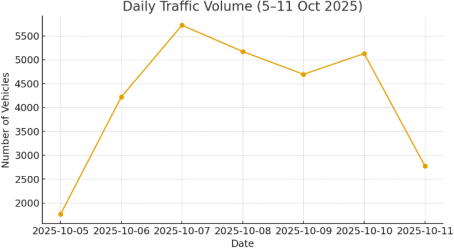
Traffic data collected over a seven-day period revealed significant variation in daily traffic volumes along the Umuaku–Isuochi road. The total weekly traffic volume was 29,479 vehicles, with a calculated Average Daily Traffic (ADT) of approximately 4,211 vehicles/day.
Figure 1. Daily Traffic Volume Umuaku-Isuochi Road.
Traffic flow exhibited a clear pattern, increasing from Sunday towards midweek and declining slightly towards the weekend. The highest traffic volume was recorded on Tuesday (5,724 vehicles), while the lowest occurred on Sunday (1,762 vehicles). This trend reflects the influence of economic and social activities, particularly market and work-related movements during weekdays.
4.2. Traffic Composition
The classification of vehicles showed that the traffic stream is dominated by light and intermediate transport modes.
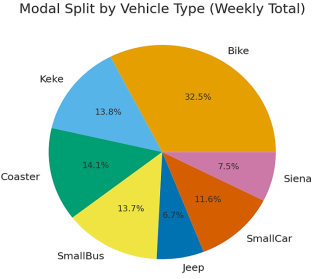
Motorcycles recorded the highest frequency across all observation days, indicating their dominance as the primary mode of transport. This reflects their adaptability to poor road conditions and affordability among users.
4.3. Traffic Flow Characteristics
The estimated average travel speed on the corridor ranged between 35–45 km/h under prevailing conditions. The weighted average operating speed was approximately 44.8 km/h, indicating moderate traffic movement.
Figure 2. Modal Split by Vehicle Type.
4.4. Level of Service (LOS)
The computed V/C ratio of 0.31 corresponds to LOS B, indicating relatively stable traffic flow with minor restrictions. However, field observations revealed that the actual driving conditions are affected by pavement deterioration, reducing effective service quality.
Table 2. PCU Calculation.
S/N | Vehicle type | Vehicle No | PCU factor | PCU |
1 | Bike (Motorcycle) | 1842 | 0.5 | 921 |
2 | Keke (Tricycle) | 769 | 1.5 | 1153.5 |
3 | Coaster Bus | 691 | 3.0 | 2073 |
4 | Small Bus | 641 | 2.5 | 1602.5 |
5 | Jeep | 387 | 2.0 | 774 |
6 | Small Car | 451 | 1.0 | 451 |
7 | Siena | 392 | 1.0 | 392 |
4.5. Pavement Condition Assessment
The pavement condition survey identified several types of surface distresses, including:
1) Alligator cracking
2) Longitudinal and transverse cracking
3) Potholes
4) Raveling
4.6. Descriptive Statistics of Traffic Data
Descriptive analysis of vehicle categories showed that:
1) Motorcycles had the highest mean daily volume (1,370 vehicles/day) and the highest variability.
2) Small buses and coaster buses also recorded high mean values, indicating their importance in passenger transport.
3) Siena vehicles had the lowest contribution and least variability.
The overall daily traffic exhibited a mean of 4,211 vehicles/day, with significant fluctuations across the week.
4.7. Correlation Analysis
Table 3 shows the correlation coefficients for each vehicle class with daily total.
Table 3. Correlation Coefficients between Each Vehicle Class and the Daily Total.
Vehicle Class | Correlation with Daily Total |
Bike | 0.918 |
Keke | 0.792 |
Coaster | 0.913 |
Small Bus | 0.924 |
Jeep | 0.896 |
Small Car | 0.531 |
Siena | 0.191 |
These results indicate that public and semi-public transport modes are the major contributors to traffic flow on the corridor.
4.8. User Perception Results
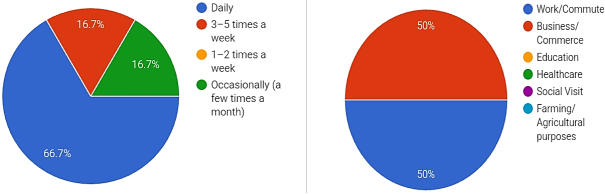
Responses from road users indicated a generally negative perception of the road condition.
4.9. Summary of Findings
The results indicate that:
1) The road experiences moderate traffic volume with clear temporal variations
2) Traffic is dominated by motorcycles and tricycles
3) The theoretical LOS is B, suggesting stable flow
4) However, the pavement condition is critically poor (PCI = 15)
5) User perception confirms low service quality despite moderate traffic conditions
Overall, the findings highlight a significant gap between traffic-based performance indicators and actual road usability, emphasizing the need for integrated road assessment approaches.
5. Discussion
The study shows that the Umuaku–Isuochi Road plays a vital economic role but is significantly constrained by poor physical condition.
Traffic analysis reveals that the road is heavily used during weekdays (about 82% of total traffic), with peaks linked to market activities, indicating that demand is influenced by local socio-economic patterns rather than being evenly distributed. Motorcycles and tricycles dominate traffic (over 58%), reflecting users’ adaptation to the deteriorated road, though this creates safety and flow challenges.
With an Average Daily Traffic (ADT) of about 4,200 vehicles, the road should perform efficiently under normal conditions. While calculations suggest a Level of Service (LOS B)—indicating stable flow—this does not match real conditions. Due to poor pavement, drainage issues, and lack of road markings, actual performance is closer to LOS C or worse, with reduced speed, comfort, and safety.
A key finding is the very low Pavement Condition Index (PCI) of 15, classifying the road as failed. This severe deterioration leads to higher travel time, increased vehicle operating costs, and greater accident risk. Traffic patterns are largely influenced by motorcycles, small buses, and coaster buses, which strongly determine overall traffic volume.
User feedback supports these findings, with most respondents rating the road as poor, highlighting potholes, discomfort, delays, and inadequate maintenance. There is also widespread dissatisfaction with the lack of government intervention.
Overall, the study concludes that although the road is economically important, it is structurally deficient and underperforming. There is a clear gap between theoretical performance and actual user experience, emphasizing the need for a more comprehensive approach to road assessment that includes pavement condition and user perception.
6. Conclusion
This study assessed the operational performance and Level of Service (LOS) of the Umuaku–Isuochi Road in Abia State through an integrated analysis of traffic characteristics, pavement condition, and user perception. The findings demonstrate that the road plays a vital role in supporting socio-economic activities within the study area, particularly in facilitating daily commuting, market access, and local transportation.
The analysis revealed that traffic flow along the corridor is moderately high, with an Average Daily Traffic (ADT) of approximately 4,200 vehicles per day. Traffic patterns showed clear temporal variation, with peak volumes occurring during weekdays, especially midweek, due to economic and market activities. The traffic composition is heavily dominated by motorcycles and tricycles, indicating a strong dependence on light, maneuverable vehicles that can cope with the deteriorated road condition.
Although the computed Volume-to-Capacity (V/C) ratio suggests a Level of Service (LOS B), indicating relatively stable flow, this does not reflect the actual operational reality of the road. The severely deteriorated pavement condition, evidenced by a Pavement Condition Index (PCI) of 15 (classified as “failed”), significantly reduces travel speed, comfort, and safety. As a result, the effective service level experienced by users is considerably lower than the theoretical rating.
The study further established that the poor condition of the road has direct economic and safety implications. Users experience increased travel time, higher vehicle operating costs, and greater exposure to accidents due to potholes, poor drainage, and lack of proper road infrastructure. The absence of consistent maintenance and limited government intervention has exacerbated the deterioration, leading to widespread user dissatisfaction.
In conclusion, the Umuaku–Isuochi Road is a critical transport link that is currently underperforming due to severe structural deficiencies and inadequate maintenance. While traffic demand remains moderate and manageable, the road’s poor physical condition undermines its operational efficiency and overall Level of Service. Therefore, comprehensive rehabilitation and improved maintenance strategies are urgently required to restore its functionality, enhance safety, and support the socio-economic development of the region.
7. Recommendations
The recommendations focus on transforming the Umuaku–Isuochi Road from a deteriorated facility into a safe, efficient, and sustainable transport corridor.
The study emphasizes the need for comprehensive rehabilitation, including full reconstruction of the pavement structure, as the current condition (PCI = 15) indicates total failure. Equally important is the provision of an effective drainage system to prevent water damage, which is a major cause of pavement deterioration.
To improve traffic operations and safety, the study recommends the installation of road markings, traffic signs, and speed control measures, alongside targeted interventions for dominant users such as motorcyclists and tricyclists. A shift from reactive repairs to a routine and preventive maintenance strategy is also critical to ensure long-term road performance.
Furthermore, the recommendations highlight the importance of user-centered planning, continuous traffic monitoring, and data-driven decision-making to align infrastructure development with actual road usage patterns. Strong government commitment, increased funding, and possible public-private partnerships are necessary to support sustainable road development. Finally, the study advocates for community involvement in maintenance reporting and the adoption of sustainable engineering practices, including climate-resilient design and lifecycle cost analysis. Overall, the recommendations promote a holistic, long-term approach that integrates engineering solutions, policy support, and community participation to enhance road performance, safety, and durability.
Abbreviations
PCU | Passenger Car Unit |
PCI | Pavement Condition Index |
LOS | Level of Service |
Acknowledgments
The authors would like to thank the Department of Civil Engineering, Edo State University, Iyamho, Nigeria, for providing the facilities used in conducting this research. Appreciation is also extended to the laboratory staff for their technical support.
Author Contributions
Ibrahim Abdulrazaq Olayinka: Supervision
Ijemen Angela Omon: Data curation, Methodology
Obebe Monisola Dorcas: Visualization
Giwa Momodu Jabir: Funding Acquisition
John Wasiu: Validation
Conflicts of Interest
The authors declare that no conflicts of interest.
References
| [1] |
Adedeji, O. A., Olanrewaju, O. A., & Ogunrinde, O. P. (2020). Sustainable pavement management in a developing economy: A performance-based approach. International Journal of Pavement Engineering, 21(14), 1783–1795.
https://doi.org/10.1080/10298436.2019.1567912
|
| [2] |
Aderinlewo, O. O., Fadugba, O. E., & Adekoya, A. F. (2021). Traffic characteristics and level of service assessment of a rural highway in Nigeria. Nigerian Journal of Technological Development, 18(2), 112–120.
https://doi.org/10.4314/njtd.v18i2.4
|
| [3] |
Adewole, A. T., Adedeji, O. A., & Olowosulu, A. T. (2023). Sustainable pavement remediation and drainage integration for rural access in sub-Saharan Africa. Journal of Infrastructure Preservation and Resilience, 4(1), 12.
https://doi.org/10.1186/s43065-023-00073-w
|
| [4] |
African Development Bank. (2021). African Economic Outlook 2021: From Debt Resolution to Growth: The Road Ahead for Africa. AfDB.
|
| [5] |
Ede, J. E., & Oshinloye, O. A. (2021). Evaluation of level of service of a rural road in Akure, Nigeria. Journal of Transportation Engineering and Traffic Management, 2(1), 1–11.
|
| [6] |
Elewi, M. H., Hassan, M. M., & El-Badawy, S. M. (2022). A comprehensive review of highway capacity and level of service: Evolution and future directions. Ain Shams Engineering Journal, 13(5).
https://doi.org/10.1016/j.asej.2022.101702
|
| [7] |
Opara, C. C. (2023). Geotechnical and pavement performance evaluation of failed road sections in Southeastern Nigeria. Journal of Civil Engineering Research, 13(2), 45–58.
|
| [8] |
Zhou, X.. (2021). Traffic volume analysis and modeling for roadway systems. Transportation Research Record, 2675(8), 112–125.
|
| [9] |
Kumar, P. (2023). Temporal traffic flow variations and their implications for road planning. Journal of Transport Geography, 102, 103374.
|
| [10] |
Singh, R. (2021). Diurnal traffic patterns and peak period analysis in developing regions. International Journal of Transportation Science and Technology, 10(3), 215–228.
|
| [11] |
Zheng, Z., & Su, D. (2023). Machine learning approaches for traffic flow prediction: A review. IEEE Transactions on Intelligent Transportation Systems, 24(5), 4567–4581.
|
Cite This Article
-
APA Style
Olayinka, I. A., Omon, I. A., Dorcas, O. M., Jabir, G. M., Wasiu, J. (2026). Assessment of Operational Performance and Level of Service of Umuaku–Isuochi Road, Abia State, Nigeria. American Journal of Traffic and Transportation Engineering, 11(3), 52-60. https://doi.org/10.11648/j.ajtte.20261103.12
 Copy
|
Copy
|
 Download
ACS Style
Olayinka, I. A.; Omon, I. A.; Dorcas, O. M.; Jabir, G. M.; Wasiu, J. Assessment of Operational Performance and Level of Service of Umuaku–Isuochi Road, Abia State, Nigeria. Am. J. Traffic Transp. Eng. 2026, 11(3), 52-60. doi: 10.11648/j.ajtte.20261103.12
Copy
|
Download
AMA Style
Olayinka IA, Omon IA, Dorcas OM, Jabir GM, Wasiu J. Assessment of Operational Performance and Level of Service of Umuaku–Isuochi Road, Abia State, Nigeria. Am J Traffic Transp Eng. 2026;11(3):52-60. doi: 10.11648/j.ajtte.20261103.12
Copy
|
Download
-
@article{10.11648/j.ajtte.20261103.12,
  author = {Ibrahim Abdulrazaq Olayinka and Ijemen Angela Omon and Obebe Monisola Dorcas and Giwa Momodu Jabir and John Wasiu},
  title = {Assessment of Operational Performance and Level of Service of Umuaku–Isuochi Road, Abia State, Nigeria},
  journal = {American Journal of Traffic and Transportation Engineering},
  volume = {11},
  number = {3},
  pages = {52-60},
  doi = {10.11648/j.ajtte.20261103.12},
  url = {https://doi.org/10.11648/j.ajtte.20261103.12},
  eprint = {https://article.sciencepublishinggroup.com/pdf/10.11648.j.ajtte.20261103.12},
  abstract = {This study assesses the operational performance and determines the Level of Service (LOS) of the Umuaku–Isuochi road in Abia State, Nigeria, a critical rural transport corridor supporting socio-economic activities. A comprehensive methodology integrating traffic flow analysis, pavement condition evaluation, and user perception surveys was adopted. Primary data were collected over a seven-day period through manual traffic counts, the moving observer method, visual pavement inspection using the Pavement Condition Index (PCI), and structured questionnaires administered to road users. Results indicate an Average Daily Traffic (ADT) of approximately 4,211 vehicles/day, with motorcycles (40.3%) and tricycles (17.7%) dominating the traffic composition. The computed Volume-to-Capacity (V/C) ratio of 0.31 suggests a theoretical LOS B, indicating relatively stable flow conditions. However, the pavement condition assessment yielded a PCI value of 15, classifying the road as “failed.” User perception further corroborates these findings, highlighting poor ride quality, safety concerns, increased travel time variability, and elevated vehicle operating costs. The study reveals a significant disparity between traffic-based performance indicators and actual service conditions due to severe pavement deterioration and inadequate drainage systems. It concludes that despite moderate traffic demand, the road performs poorly in delivering efficient and safe transportation services. The study recommends immediate full-scale rehabilitation, improved drainage infrastructure, and the implementation of routine maintenance strategies to restore functionality and enhance overall road performance.},
 year = {2026}
}
Copy
|
Download
-
TY  - JOUR
T1  - Assessment of Operational Performance and Level of Service of Umuaku–Isuochi Road, Abia State, Nigeria
AU  - Ibrahim Abdulrazaq Olayinka
AU  - Ijemen Angela Omon
AU  - Obebe Monisola Dorcas
AU  - Giwa Momodu Jabir
AU  - John Wasiu
Y1  - 2026/08/22
PY  - 2026
N1  - https://doi.org/10.11648/j.ajtte.20261103.12
DO  - 10.11648/j.ajtte.20261103.12
T2  - American Journal of Traffic and Transportation Engineering
JF  - American Journal of Traffic and Transportation Engineering
JO  - American Journal of Traffic and Transportation Engineering
SP  - 52
EP  - 60
PB  - Science Publishing Group
SN  - 2578-8604
UR  - https://doi.org/10.11648/j.ajtte.20261103.12
AB  - This study assesses the operational performance and determines the Level of Service (LOS) of the Umuaku–Isuochi road in Abia State, Nigeria, a critical rural transport corridor supporting socio-economic activities. A comprehensive methodology integrating traffic flow analysis, pavement condition evaluation, and user perception surveys was adopted. Primary data were collected over a seven-day period through manual traffic counts, the moving observer method, visual pavement inspection using the Pavement Condition Index (PCI), and structured questionnaires administered to road users. Results indicate an Average Daily Traffic (ADT) of approximately 4,211 vehicles/day, with motorcycles (40.3%) and tricycles (17.7%) dominating the traffic composition. The computed Volume-to-Capacity (V/C) ratio of 0.31 suggests a theoretical LOS B, indicating relatively stable flow conditions. However, the pavement condition assessment yielded a PCI value of 15, classifying the road as “failed.” User perception further corroborates these findings, highlighting poor ride quality, safety concerns, increased travel time variability, and elevated vehicle operating costs. The study reveals a significant disparity between traffic-based performance indicators and actual service conditions due to severe pavement deterioration and inadequate drainage systems. It concludes that despite moderate traffic demand, the road performs poorly in delivering efficient and safe transportation services. The study recommends immediate full-scale rehabilitation, improved drainage infrastructure, and the implementation of routine maintenance strategies to restore functionality and enhance overall road performance.
VL  - 11
IS  - 3
ER  -
Copy
|
Download





 Share This Article
 Twitter
 Linked In
 Facebook